
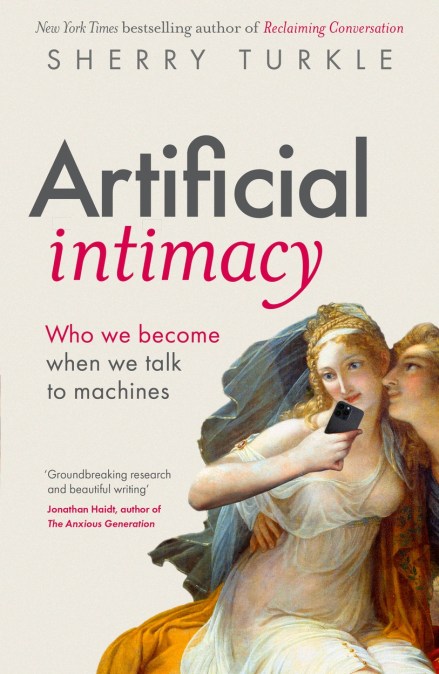
Social media came for our attention – now Chatbots are coming for our relationships.
Nearly one-third of adults now turn to AI programmes like ChatGPT for companionship. For Gen Z, the figures are even more stark: eight out of ten say they could form a deep emotional attachment with a machine.
It’s not hard to see why. Chatbots offer the fantasy of the perfect partner: endlessly available, endlessly attentive, always affirming.
But as MIT professor Sherry Turkle discovers by speaking to people who use chatbots as confidants, therapists, carers and lovers, these hallucinatory bonds come at great cost. The more we ask machines to care for us, the less we expect from – and give to – other people. AI deepens the loneliness it claims to cure.
For decades, Turkle has been the leading voice on how digital technologies erode connection. Now, blending vivid storytelling with sharp cultural critique, she turns her attention to a technology that has convinced so many that the performance of empathy is empathy enough.
Essential reading for parents and children, clinicians and patients, managers and employees, Artificial Intimacy offers both a cautionary tale and a roadmap for being human in the age of AI.
“In a time in which the ways we communicate and connect are constantly changing, and not always for the better, Sherry Turkle provides a much needed voice of caution and reason to help explain what the f*** is going on.”
Aziz Ansari on Reclaiming Conversation
Nearly one-third of adults now turn to AI programmes like ChatGPT for companionship. For Gen Z, the figures are even more stark: eight out of ten say they could form a deep emotional attachment with a machine.
It’s not hard to see why. Chatbots offer the fantasy of the perfect partner: endlessly available, endlessly attentive, always affirming.
But as MIT professor Sherry Turkle discovers by speaking to people who use chatbots as confidants, therapists, carers and lovers, these hallucinatory bonds come at great cost. The more we ask machines to care for us, the less we expect from – and give to – other people. AI deepens the loneliness it claims to cure.
For decades, Turkle has been the leading voice on how digital technologies erode connection. Now, blending vivid storytelling with sharp cultural critique, she turns her attention to a technology that has convinced so many that the performance of empathy is empathy enough.
Essential reading for parents and children, clinicians and patients, managers and employees, Artificial Intimacy offers both a cautionary tale and a roadmap for being human in the age of AI.
“In a time in which the ways we communicate and connect are constantly changing, and not always for the better, Sherry Turkle provides a much needed voice of caution and reason to help explain what the f*** is going on.”
Aziz Ansari on Reclaiming Conversation
Reviews
The preeminent sociologist of smart machines, Sherry Turkle, now writes against the techno-utopianism of our time and the promise of frictionless intimacy, chronicling the distinction between virtual and actual human community and connection
The best thing I've ever read about one of the biggest questions of our time: how will we relate to machines as they become more like us? Sherry Turkle's book is insightful, emotional, rigorous, and deeply human. Read it cover to cover and absorb its wisdom; don't, whatever you do, just ask a bot to summarize it
A pointed critique of the growing impact of artificial intelligence on human relationships . . . Turkle urges readers to question whether these tools enhance or inhibit personal growth. Harrowing and poignant, this timely warning deserves to be widely read
All around us, people are beguiled by the siren song of artificial intimacy. Chatbots offer inexpensive therapy, friendship, sexual fantasy, and even romantic love. Sherry Turkle's 40 years of groundbreaking research and beautiful writing make her the most qualified member of Team Humanity to call us back to our senses, and to each other
Sherry Turkle, our wisest guide to digital life, has written her most urgent book yet. Artificial Intimacy will help you avoid the profound but often hidden threats AI poses to you and your relationships. Read it and share it with all the humans you know
A necessary exploration of what happens when we seek the comforts of connection over the demands of relationships. A must-read for anyone engaging with AI today. That just about means all of us
Sherry Turkle is the exact right person at the exact right time to write us this exact book. A warning of what we must protect in our age of AI and a celebration of what it is to be human, Artificial Intimacy it is a love letter to humanity written by a woman of brilliance and heart
Our relational nature as human beings is being colonized by machines that cleverly exploit our longing for human connection, simulate intimacy, and ultimately entrain us into a world of pretend ― artificial intimacy. May this book reinforce our commitment to trust and inhabit our analog nature as human beings, and resist wholesale digital capture